While Yazidi people (the original monotheists from which Jews,
Christians and muslims took their "faiths") and other non-muslims (and
wrong-muslims) are raped, terrorized, slaughtered or forced to "convert"
to islam, Ahmed and Warsi are busy defending the muslim terror
organization Hamas
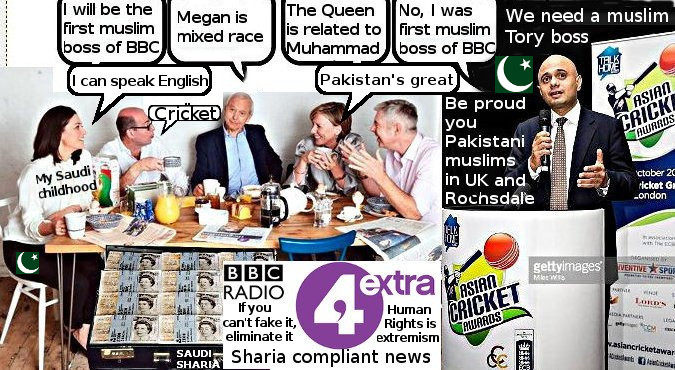
Take a look at the two faces in the
middle of this pic that Klevius has used for many years to enlighten the
problem with islam. They are both old pals fighting for political islam
and against Human Rights - not necessarily for the parties they
repesent. Ahmed is a muslim who uses Labor party in his jihad while
Warsi uses the Conservative party in hers. They are both rooted in
Pakistan (Kashmir area) and they have both been deeply involved in
scandals that would have put a non-muslim far away from any political
post. More about Warsi furthest down on this posting.
A glossy popular history magazine now describes plundering Medieval muslims and Vikings in completely opposite ways. Why?!
Whereas 'the caravan robbing muslims' (and that's what the magazine
actually writes) are called 'the followers of a new faith' and their
plundering in Mideast, Africa, Asia and Europe is positively described
as 'successful conquest' (while the European defense is called 'evil
crusaders'), the Vikings are just negatively dismissed as evil
'Barbarians' from the north who 'devastated the whole of Europe'.
Klevius history lesson about the muslims and the Vikings
The "extremist" parts of the Koran are exactly the ones that count for
true muslims and historical records. Without following precisely those
extremist parts of the Koran there wouldn't have been any islam at all.
However, although the Viking phenomenon as such was a direct consequence
of muslim evilness, the forceful Vikings themselves didn't come out of
the blue but represented an amplification of a pre-existing historical
pattern that goes back to the Goths. And so far only Klevius (who is a
late Goth/Finland-Swede) seems to have found the quite obvious source
code for this transition.
In short it goes as follows:
This advanced sword from Vendel in Uppland Sweden is dated to a time
before the Vikings when Uppland was still generally Finnish or at least
bi-lingual. It's just one of many examples clearly revealing an
alternative understanding of how the "barbarian" "Pagans" from the north
could topple the Christian Roman empire. Although the sword is from
Vendel time, i.e. after the fall of the Romans, it has to be put in
context with the Goths (see below).
Birka (east of Stockholm) was established in the middle of the 8th
century and thus being one of the earliest urban settlements in
Scandinavia. Birka became part of a Baltic/Bay of Finland link in the
pre-existing river and portage routes through Ladoga (Aldeigja) and
Novgorod (Holmsgard) to the Byzantine Empire and the parasitic
islamofascist Abbasid slave Caliphate.
The Goths
Acknowledgement: It's extremely problematic and even embarrassing for
Klevius as a Finland-Swede, and as a person who brags about
self-criticism being his main scientific tool, to end up with his own
ethnicity as having been a major global player in the past. However,
there are some mitigating excuses. So for example, what made some
Finland-Swedes to become Goths and Vikings etc. were not necessarily the
most sought after human characteristics. Moreover, those Finland-Swedes
who didn't participate became today's tiny and on the verge of
extinction Finland-Swedish community, linguistically bullied by the
Finns (language) as well as the Swedes (accent/dialects).
Btw, dear reader, why don't you dare
to comment, ask questions etc? Isn't the topic interesting and
challenging enough, or is it because you're a coward and don't want to
be known as reading something critical of islam, the worst ideological
crime ever against humanity?
The oldest runic inscription found is some 600 years before the Viking
age - and it is Finnish (or more probably Finnish-Old Nordic, i.e. what
Klevius terms Finland-Swedish)
This is the oldest runic (Futark) inscription found. It says HARJA which is
exactly the same as 'harja', meaning comb or , brush or ridge, in modern Finnish.
The word is etymologically very old and had this Finnish form when the
comb was made, i.e. it cannot be confused with some non-Finnish
interpretation. Moreover, the word is found in all sister languages. The possibly related Baltic (or other) words do not
resemble it at all neither now nor back then. The comb was found in
Denmark and is dated to 160 CE (same time as the birth of Fornjotr, king
of
Kvenland and Gotland). However, also keep in mind that the combs owner also spole old Nordic.
Warning! There are many
confused "scientists" out there
emotionally trying to dismiss the Nordic origin of the Goths. I even
stumbled on one who thought that different spellings would mean
different groups. Spellings etc don't matter here. Just like 'Vikings'
the 'Goths' is more of a concept than a
specific ethnicity - just like 'muslims', except for the fact that
muslim evilness is still kept alive under the cover of 'religion'.
The name 'Goth' (in its many variants) reflects
the fact that it's not only thoroughly anchored in a Finnish-Old Nordic
geographical/linguistic area and context but also that Gothic is linguistically
puzzling if you don't see it as an Uralic colored form of Old Nordic.
Moreover, genetics is still in its cradle and hence an extremely fragile
tool. Only very crude main chronologies can so far be established and
even shallow dives result in progressive guesswork at best, no matter
how fancy math and graphs are produced. Klevius will explain more on
this exciting topic later. However, so far nothing in genetics seems to disprove Klevius' analysis.
To understand the confusing picture about Finnish-Old Nordic relations
that seems to emerge, one has to consider the relation between
Indoeuropean and Uralic/Finnish languages. Both groups stem from
geographically overlapping areas. However, whereas the former was more
sedentary and farming oriented the latter was older and more rooted in a
hunter-gatherer context.
As we all know agricultural societies usually gained more wealth and
population than nomads etc. So when they moved north the Germanic tribes tended to
follow a path more favorable for farming (Germany, Denmark and southern Sweden). This is how the linguistic map
evolved in northern Europe, divided between the Finnish/Uralic related and Germanic/Indoeuropean tribes.
The Langobards - an example of how a tiny amount of Finland-Swedes (Kvens) conquered Europa
The Lombards or Langobards (Germanic word meaning the 'long-bearded' or
the 'long-boarded') Latin: Langobardī, Italian Longobardi), were a north
Germanic (Gothic?) tribe traceable to Gotland (Scadanan) who ruled
Italy from 568 to 774.
Paul the Deacon wrote in the Historia Langobardorum that the Lombards descended from
a small tribe called the Winnili (or Vinnili or Finnili) who dwelt in
southern Scandinavia (Scadanan, i.e. Gotland) before migrating to seek new lands. In the 1st century AD
they formed part of the Suebi*,
in northwestern Germany. By the end of the 5th century they had moved
into the area roughly coinciding with modern Austria north of the Danube
river, where they subdued the Heruls and later fought frequent wars
with the Gepids. The Lombard king Audoin defeated the Gepid leader
Thurisind in 551 or 552; his successor Alboin eventually destroyed the
Gepids at the Battle of Asfeld in 567.
* From Proto-Germanic *swēbaz, either
based on the Proto-Germanic root *swē- meaning "one's own" people, or on
the third-person reflexive pronoun; or from an earlier Indo-European
root *swe-. The etymological sources list the following ethnic names as
also from the same root: Suiones, Semnones, Samnites, Sabelli, Sabini,
indicating the possibility of a prior Indo-European ethnic name, "our
own people". Ultimately the word may also be related to 'sib' with
similar meaning.
Following this victory, Alboin decided to lead his people to Italy,
which had become severely depopulated after the long Gothic War
(535–554) between the Byzantine Empire and the Ostrogothic Kingdom
there. The Lombards were joined by numerous Saxons, Heruls, Gepids,
Bulgars, Thuringians, and Ostrogoths, and their invasion of Italy was
almost unopposed. By late 569 they had conquered all the principal
cities north of the Po River except Pavia, which fell in 572. At the
same time, they occupied areas in central and southern Italy. They
established a Lombard Kingdom in Italy, later named Regnum Italicum
("Kingdom of Italy"), which reached its zenith under the 8th-century
ruler Liutprand. In 774, the Kingdom was conquered by the Frankish King
Charlemagne and integrated into his Empire.
Vikings
From Altai to Gotland, Sami, God, Vikings, Shakespeare and Tolkien
Klevius etymology and history remarks relating to the Britain-Scandinavia connection:
The ancient Persian (which is extremely young compared to Uralic) word
for god 'khoda' connects to the even more ancient Finnish 'koti' and
Finno-Ugric 'kota' (=home/house/seed vessel - see
Klevius definition of religion
and the Vagina gate), Saami 'goahti'. German Gott (god) and Swedish
gott (good) as well as Gotland (pronounced Gottland), the island in the
Baltic sea that constituted a (the?) main Viking hub in their slave
trade with Jews and muslims.
Gotland in particular is famous as the probable ancestral home of the
Goths: "a Gothic population had crossed the Baltic Sea before the 2nd
century AD, reaching Scythia at the coast of the Black Sea in modern
Ukraine where Goths left their archaeological traces in the Chernyakhov
culture. In the 5th and 6th centuries, they became divided as the
Visigoths and the Ostrogoths, and established powerful successor-states
of the Roman Empire in the Iberian peninsula and Italy. Crimean Gothic
communities appear to have survived intact in Crimea until the late
18th century.
Hamlet was aGoth
The father of Shakespeare's prototype for Hamlet was a Goth from the
Gothenburg area in Sweden (were Klevius father also happened to be
born). These Goths came originally from Gotland via those very same
waterways that were shaped already some 9,000 years ago, hence
connecting the Baltic Sea with Doggerland/North Sea.
Gotland was also the home port and treasure island for the Vikings
because it naturally connected West and East via Staraja Ladoga
southeast of Finland on the river way down to the south. Gotland has
revealed the biggest hoards of Viking age old Arab/islamic silver coins
in Northern Europe.
Immediately north of Staraja Ladoga is the homeland of the Finnish national epic Kalevala which Tolkien based his writing on.
The world's oldest fishing net is found in southeastern Finland and is
some thousand years older than Cheddar man the "oldest Brit".
Bromme culture existed in what is today's Sweden already 11,700–11,000 bp.
As a curiosity it might be noted that film director Ingmar Bergman lived
most of his life on Gotland where some of his most powerful movies
were filmed.
In conclusion one might well argue that the Baltic Sea has been a main hub since the birth of modern humans.


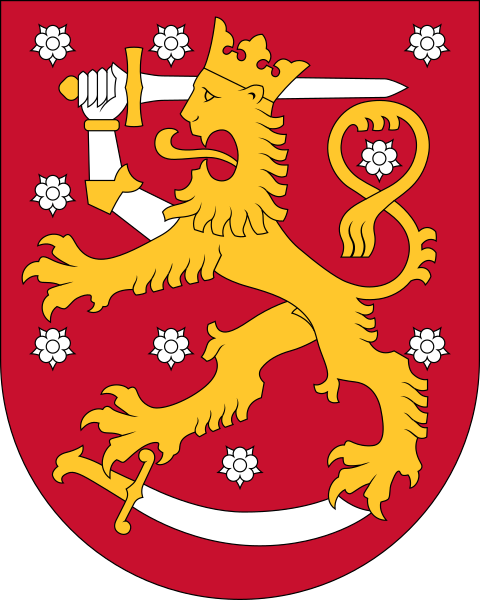
The first version at the top made 1583 and below how it looks today.
The sword held over the lion's head represents the West whereas the one
below the lion represents islam (via Khazars, Bolgars, Ottomans etc. -
see text below).
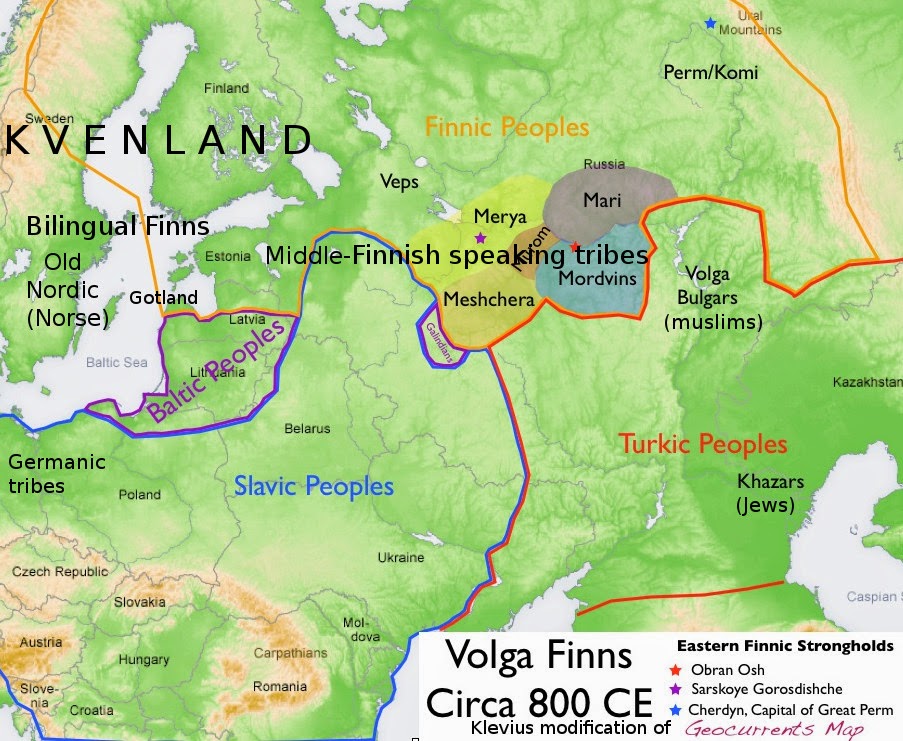
Finland/Kvenland - the home of Kalevala and the Vikings
Background
Precisely because the farming old Swedes were more numerous and
wealthier than the Finnish speaking nomads, the original Finland-Swedish
Vikings became "Swedisized". As a consequence the later Viking age
looked more "Swedish". The oxymoron "Norwegian Vikings", however, has no
place at all in history because neither Norwegian language nor
Norwegians existed at that time.
Unlike muslims who only copied/stole (incl. "converts") what others had
made possible, the Vikings really contributed something new.
Finland has two official languages, Swedish and Finnish. Finland is also
one of the most secularized countries in the world. Finland (and huge
parts of what is now Sweden and Norway) was Kvenland before the
Christian crusades after which it became connected as part of Sweden for
some 600 years until the 1808-9 war against Russia after which Finland
became an autonomous Grand Duchy in the Russian Empire until Finland's
independence 6, December 1917.
After the 1808-9 war the Swedish speaking intellectuals started a
campaign, "we are no Swedes anymore, and we don't wanna be Russians - so
let's be Finns". This strive made many a Finland-Swede translate their
name into Finnish. It also resulted in the collection of the Kalevala
epos (which Tolkien used as a basis for his stories). However, Elias
Lönnroth's Kalevala was heavily influenced by a monotheist
understanding. Luckily Juha Pentikäinen and others have now initiated a
rewriting of the text clean from Christian monotheist influences.
Due to its location Finnish (and Saami) possesses extremely old words
still in use (see below). And due to the interaction between old Nordic
and Finnish a pattern emerged that can still be seen stretching from
Finland all the way to Iceland (see below).
No one knows the true origin of the name Kvenland. However, Klevius
qualified guess is based on its history of Nordic (and Finnish) speaking
(agrarian) coastal Finns robbing beautiful girls with mongoloid
characteristics (which pattern you can also trace in reading Kalevala)
from its Saami and Finnish speaking neighbors. Raids with light boats
was a Finnish specialty inherited from the Finnish and Russian water
ways they still frequented (see
Origin of Vikings).
And when they heard (from the Volga Bolgars and the Jewish Khazars etc)
about the enormous demand and price the muslim caliphate paid for these
kind of girls the commerce quickly changed from furs to walking girls.
Due to the mix of old Nordic speaking males and Finnish speaking women
an early bilingual traditon was born, which helped dealing with both
Swedes and Finnish speaking "Russians". At the beginning of the Viking
age the "Russians" spoke Finnish which was the main language in what is
now northern and mid Russia. This also explains how Fornjotur could be
the King of both Finland and Gotland as well as how Rus could become so
friendly with the pre-Russians that they asked him for protection
against other Vikings, Jews (Khazars) etc.
Finland has for long suffered from what
Klevius calls a mongoloid complex (2003).
In 1952, only seven years after the end of
Finland's disastrous connection with Germany in the World War 2, apart
from having its first Olympics the nation celebrated the 17-year old
Armi Kuusela's victory in the Miss Universe "beauty" contest, thus
finally releasing the Finns from what was considered a traumatic
connection with the East and its Russian/mongoloid inhabitants.
Klevius' ethnicity
The tiny (some 300,000) Finland-Swedish ethnic minority has, apart from
the tiresome, bragging and annoying islamophobe named Klevius, produced
such names as Edith Södergran (modernist poet), Westermarck
(anthropology), Jean Sibelius (music), Georg Henrik von Wright
(Wittgenstein's successor), Lasse Wiren (athletics - double-double
Olympic winner on 5,000m and 10,000m), Lindberg (music - Kraft etc),
Linus Thorvald (Linux), etc etc.
This list clearly implies a Finland-Swedish complex or something (see
Inside Klevius mind).
Why surprised about the fact that English is a Nordic language? Klevius has informed about it for almost a decade on the web!
* When Klevius shakes hand with native
English speakers he loves to point out that 'finger', 'hand', and 'arm'
all are Swedish words with exactly the same spelling and not too different pronunciation.
This usually produces a nice "really". However, when he also points out
that most of the non-Latin words in English also are Swedish a brief
uncertain and incredulous retreat from the topic is noticeable. And, now
finally the self-evident fact that even grammar is equal has been pointed out even by others.
English is a Scandinavian/Nordic (Fennoscandian*) language
*
No one knows for how long Old Swedish/Nordic language(s) has been
spoken in Finland. This is why not only the Scandinavian part but the whole
Fennoscandian peninsula ought to be included.
Jan Terje Faarlund, professor of linguistics at the University of
Oslo. "Obviously there are many English words that resemble
ours. But there is something more: its fundamental structure is
strikingly similar to Norwegian.
Klevius (who understands all Nordic languages incl. Finnish and
most dialects): Norwegian language emerged after the Viking period (see
Origin of Vikings).
Its predecessor, i.e. what is called "Old Norse" but perhaps rather
should be called Old Swedish or Old Nordic, is rooted in Kvenland from
the cross pollination of Finnish and Nordic Germanic. Kvenish today is
still very close to Finnish (more so than e.g. Estonian) yet it also
contains such pecularities as meiðän ('our') which is simply meidän in
Standard Finnish with a normally sounding d instead of the English
sounding ð.
Kvenland (Womanland) from Finno-Ugric/Uralic to Old Swedish/Scandinavian/Nordic*
*aka "Old Norse" which might lead associations to Norway although there
were no Norwegian speakers around long after the Viking age (see
Origin of Vikings).
Kvenland, aka
Cwenland,
Kænland,
Queenland, Kvinnoland, Womanland etc, is an ancient name for an area in
Fennoscandia.
Compare Swedish 'Kvinna' (woman) and English 'Queen' as well as
Norwegian 'kone' (woman) Swedish 'kön' (sex) and English 'kin' (yes, we
have Indoeuropean 'gen' but so what, where did 'gen' emerge?).
There exists a persistent "wikimyth" that Finnish language in Sweden and
Norway are just a few hundred years old when in fact it's thousands of
years old but due to national romanticism was explained away as caused
by late immigration only.
As I already said, no one knows for sure why it was called Kvenland.
However, a strong hypothesis is that the name reflects sex-slave hunt
for beautiful white girls/women who were most valued on the muslim slave
markets by the islamic mosques. So the Finnish empire may have existed
long before it was called Kvenland.The name was just applied from the
outside as a marker of its notorious records.
Kvenland appears in written sourdes from the 9th century, and from Icelandic sources written
in the 12th and 13th centuries. Since the 17th century most historians
have located Kvenland somewhere around or near the
Bothnian Bay, in the present-day regions of Swedish
Norrbotten and Finnish
Ostrobothnia as well as part of Norway where there are still a Kvenish population. The traditional East Finnish name of this area was
Kainuu, and it has been suggested that the Scandinavian name of Kvenland and Kainuu share etymological roots.
Around 890 CE a Northman named
Ohthere visited
King Alfred of Wessex who had his stories written down by
Orosius.
According to Ohthere, the Norðmanna land was very long
and very narrow ... and to the east are wild mountains, parallel to the
cultivated land. Finnas inhabit these mountains ... Then along this land southwards, on the other side of the mountain, is
Sweden
... and along that land northwards, Kvenland (Cwenaland). The Kvens
(Cwenas) sometimes make depredations on the Northmen over the mountain,
and sometimes the Northmen on them.
There are large [freshwater]
meres amongst the mountains,
[2]
and the Kvens carry their ships over land into the meres, and thence
make depredations on the Northmen; they have small and very
light ships.
Fornjotur* (ca 160-250 CE), the Finnish King of Kvenland and Gotland,
and ancestor of the Swedish Ynglinga tree and William I of England
* there is much reason to believe that
the legend about Fornjotur has more truth underneath than for example
the myth about Mohammed (who was allegedly born 400 years later). Hugh
Kennedy (professor of Arabic language and Arabic history): "Before Abd al-Malik (caliph 685-705) Mohammed (dead 632) is never mentioned on any official document whatsoever..."
Fornjotur, Fornjót,
Fornjótr) was a
king of Finland. His children are
Ægir (the ruler of the sea),
Logi (fire giant) and Kári (god of wind).
The name has often been interpreted as
forn-jótr "ancient giant", and sometimes identified with the primeval giant
Ymir.
But it is also possible, as was suggested by Müller (1818), that it is
one of a well-established group of names or titles of gods in
-njótr "user, owner, possessor", which would make Fornjótr the "original owner".
How did primary stress on first syllable come from Kvenland to Iceland?
There was of course another language, Kvenish-Finnish, that was present
in Fennoscandia and somehow influenced the ancient Norse language.
Finnish possesses some of the oldest words in the world, some of them
still in their original Uralic form. In fact, the old Finnish stem seems
to be closer to its distant roots than other Finno-Ugric languages
despite the fact that Finland has been the most modernized of them all.
Klevius linguistic question: How was the strange affinity between
Indoeuropean Icelandic and Uralic Finnish created between Kvenland and
Iceland?
Whereas Indoeuropean languages are strongly rooted in a Neolithic
agricultural past Uralic languages are rooted in hunting/gathering
societies i.e. pre-Neolithic.
Indoeuropean Old Norse developed into "Western" and "Eastern" variants. Western Norse
covered Norway and overseas settlements in Iceland, Greenland, the
Faroe Islands and the Shetland Islands, while Eastern Norse developed in
Denmark and south-central
Sweden and coastal Finland.
The language of Iceland and the non Finnish or Saami Fennoscandia was practically the same up until
the 14th century, when they started to deviate from each other.
During the late Old
Norse period and this period there was also a considerable adoption of
Middle Low German vocabulary. Similar development in grammar and phonology happened in Swedish and Danish, keeping the
dialect continuum
in continental Scandinavia intact, but with greater dialectal
variation. This process did not, however, occur in the same way in
Faroese and
Icelandic.
These languages remain conservative to this day, when it comes to
grammar and vocabulary, so mutual intelligibility with continental
Scandinavia was lost.
The Uralic languages belong to a single Eurasian belt of agglutinative
languages together with the Altaic languages streching from Fennoscandia
in the west to Japan in the east
Not only typological parallelism, but also stress on the first syllable
as well as lack of third person pronoun sex segregation (e.g. Finnish
'hän' instead of 'he/she' apartheid) is accompanied by areal adjacency,
allowing us to speak of a distinct Ural-Altaic language area and
language type we may call Eurasiatic.
Some roots for Eurasiatic: mi (what?, mi/kä or mi/tä in modern Finnish),
pälä (two), akʷā (water), tik (one or finger), konV (arm 1), bhāghu(s)
(arm 2), bük(ä) (bend or knee), punče (hair), p'ut'V (vagina or vulva),
snā (smell or nose), kamu (seize or squeeze), and parV (the verb to fly)
Modern Finnish preserves old words equal or almost equal more often than other languages
Examples of reconstructed Proto-Uralic words:
Body parts and bodily functions: *ïpti hair on the head, *ojwa head,
*śilmä eye (same as in modern Finnish), *poski cheek (same as in modern
Finnish), *kä(x)li tongue ('kieli' in modern Finnish), *elä- to live
('elää' in modern Finnish), *ka(x)li- to die ('kuolla', and 'kuoli' in
imperf), *wajŋi breath (in Finnish 'vainaja' means a dead), *kosi cough,
*kunśi urine ('kusi' in modern Finnish), *küńili tear ('kyynele' in
modern Finnish), *se(x)ji pus.
Kinship terms: *emä mother (same in modern Finnish), *čečä uncle ('setä'
in modern Finnish), *koska aunt, *mińä daughter-in-law ('miniä' in
modern Finnish), *wäŋiw son-in-law ('vävy' in modern Finnish).
Verbs for universally known actions: *meni- to go ('mennä', 'meni' in
imperf in modern Finnish), *toli- to come ('tulla', 'tuli' in imperf in
modern Finnish), *aśkili- to step ('askel' is step in modern Finnish),
*imi- to suck ('imi' is sucked in modern Finnish), *soski- to chew,
*pala- to eat up ('pala' is a piece in modern Finnish), *uji- to swim
('ui' is swim in imperf in modern Finnish), *sala- to steal ('salata'
means to hide in modern Finnish), *kupsa- to extinguish ('kupsata' used
for to die in modern Finnish).
Basic objects and concepts of the natural world: *juka river ('joki' in
modern Finnish), *toxi lake, *weti water ('vesi/vettä' in modern
Finnish), *päjwä sun (same but also day in modern Finnish), warmth,
*suŋi summer ('suvi' in modern Finnish), *śala- lightning ('salama' in
modern Finnish), *wanča root ('vanka', 'vankka' means steady in modern
Finnish), *ko(x)ji birch, *ka(x)si spruce ('kuusi' in modern Finnish),
*sïksi Siberian pine, *δ'ï(x)mi bird cherry
Elementary technology: *tuli fire (same in modern Finnish), *śüδi coal,
*äjmä needle, *pura drill ('pora' in modern Finnish), *jïŋsi bow
('jousi' in modern Finnish), *jänti bow string, *ńï(x)li arrow ('nuoli'
in modern Finnish), *δ'ümä glue ('liima' in modern Finnish), *lïpśi
cradle, *piksi rope, *suksi ski (same in modern Finnish), *woča fence.
Basic spatial concepts: *ïla below ('alla' in modern Finnish), *üli
above ('yli' in modern Finnish), *wasa left ('vasen' in modern Finnish),
*pälä side.
Pronouns: *mun I (meaning mine in modern Finnish), *tun you ('sun'
meaning yours in modern Finnish), *ke- who (same in modern Finnish),
*mi- what (same in modern Finnish).
The reconstructed vocabulary is compatible with a Mesolithic culture
(bow, arrow, needle, sinew, but also rope, fence, cradle, ski), a north
Eurasian landscape (spruce, birch, Siberian pine), and contains
interesting hints on kinship structure.
The Vikings were bilingual (Finland-Swedes) Goths who could communicate
both with the Finnish tribes as well as with the old Nordic/German
people
In the Viking world the Jewish slave empire (Chazaria) played an
important role in establishing the slave raid and trade system that
served the enormous islamic hunger for white sex slaves.
Karelia's old coat of arms.
Karelia bordered the medieval Novgorod republic which was ransacked by
muslim Bolgars who hunted for slaves. The southern part became an
important hub in the islamic slave finance as Vikings and Kazar Jews etc
served the islaic caliphate in the south and later on the Ottoman
Turks.
Fair skinned female sex slaves from northern Europe were the by far most valuable according to islamic price lists
(see more about this
here)
Most of what you read about Vikings on the web is wrong. The Viking age started already before 750 in the east (because of
islamic demand for sex slaves).
So forget about Britain 786. Also remember that if you see the words
Norway or Norwegians mentioned re. Vikings then throw the link/book
away. There was no Norway or Norwegians or a Norwegian language during
the Viking age! Educate yourself on
Origin of the Vikings.
In 882, Rurik's successor, Oleg of Novgorod, conquered Kiev and founded the state of Kievan Rus.
After the Kievan Russian state began to disintegrate in 1132, slaves
became much more numerous as inhabitants of neighboring East Slavic
principalities (much of the territory between Poland-Lithuania and the
Volga River) became fair game for enslavement.
Jewish merchants took East Slavic slaves from Novgorod to western
destinations. Other East Slavic slaves were continuously "harvested" by
the Turkic peoples (Tatars) inhabiting the southern and eastern
frontiers of Rus' and subsequently sold to buyers mainly in the Arab
countries.
The Mongol invasions into Rus' from 1236-1240 accelerated the disintegration of Kievan Rus' that had commenced in 1132.
Continuous Tatar slave raids replaced those of the pre-1240 Turkic
peoples who had roamed the Ukranian steppe. In these centuries the word
"slave" was borrowed from the ethnonym "Slav."
During the ensuing period of the "Tatar yoke" (1237-1480), the export of
slaves through Novgorod continued and the Novgorodian slave market at
the intersection of Slave and High Streets was the most active business
locale in the entire Republic of Novgorod, which encompassed much of
Russia north of the Volga to the White Sea.
The Crimean Tatars had converted to islam in the 1300s and in 1475 the
Crimean Khanate became a protectorate of the Ottoman Empire while itself
still clinging to power over the Duchy of Muscovy. In 1480, the
Muscovites threw off the "Tatar Yoke" and began the unification of
Russia under Slavic rulers. By 1503, those rulers would declare Russia
the Third Roman Empire, and take the title of Tsar.
The Crimean Tatars made use of their strategic position between the
Ottomans and the Russians and supplied slaves for the Ottoman Janissary
corps from the neighboring peoples to an enormous extent yet to be fully
mapped.
Greedy rulers either married a muslim and naively agreed* to convert or
just found islam the perfect sword for evil but profitable slave finance
* Islam is an evil dead end. A
totalitarian harpoon that has only one direction unless it's stopped.
This is one of the many reasons why islam is completely out of sync with
Human Rights - a fact that not only Klevius but also OIC has realized!
Little is known about the timeline of the islamization of Inner Asia and
the Turkic peoples who lay beyond the bounds of the caliphate. Around
7th century and 8th century, there were some states of Turkic peoples
like Turkic Khazar Khaganate and Turkic Turgesh Khaganete who fought
against the caliphate in order to stop Arabization and islamization in
Asia. From the 9th century onwards, the Turks (at least individually, if
not yet through adoption by their states) began to convert to islam.
The Bulgars of the Volga, to whom the modern Volga Tatars trace their
islamic roots, are noted to have adopted islamic evil early on. When the
Friar William of Rubruck visited the encampment of Batu Khan of the
Golden Horde, who had recently completed the Mongol invasion of Volga
Bulgaria, he noted "I wonder what devil carried the law of Machomet
there".
Different political functions of the islamic myth to legitimate power
Quite contrary to the populist academic discourse that within an islamic
worldview, the production of "eventually" correct ritual behavior can
be a gateway for "the grace of Allah" to produce "correct belief", the
crude reality of islam's own tenets points clearly - and without the
slightest anomaly from non-islamic history in sight - to a profitable
parasitic formula crudely chiseled on pre-existing Judaic dogmas. This
formula, which in one sweep eliminates otherwise "puzzling" historical
events, goes like this (taken from www.klevius.info):
The root formula of Islam (Klevius 2001)
Slavery+"infidel" racism+sex segregated rapetivism+anti human rights Sharia/apostasy ban.
Why isn't the worst crime ever against humanity criminalized, but instead protected by the very Human Rights islam opposes?!
Converts to islam don't have to understand anything to be a "good
muslim" simply because accepting totalitarian islam is the only proof
needed. However, other muslims might not approve of it...
A non-elected muslim extremist, Sayeeda Warsi, is robbing Brits (incl. Sharia opposing muslims) of their Human Rights*
* Always remember that Sharia in
OIC's Cairo declaration is called "islamic human rights", i.e. despite
they are just the opposite to the most basic of Human Rights!
The islamofascist propaganda war today resembles the German National-socialists' (aka Nazis) of the 1930s.
Sayeeda Warsi and the Saudi based OIC's islamofascist agenda
Concerns have been raised by the National Secular Society that the
UK's stance on free speech could be compromised by an agreement
signed at the United Nations between UK and the
Organisation of Islamic Co-operation (OIC).
The Memorandum of Understanding (MoU) was signed by Baroness
Sayeeda Warsi – the new "Minister for Faith" - and
pledges that the UK and the OIC will "work together on issues of
peace, stability and religious freedom."
At present, the OIC is agitating at the United Nations for a
global blasphemy law that would make criticising or satirising
religion a punishable offence.
Terry Sanderson: Baroness Warsi needs to be challenged on her
theocratic ambitions. We think it is important to track what the
Government is doing in our name, and so we are reproducing below a
statement by Baroness Warsi that was published in The Tablet this week.
You will remember that Baroness Warsi is the rather elaborately titled
"Senior Minister of State at the Foreign and Commonwealth Office and
Minister for Faith and Communities."
You will also remember that she is not an elected Government Minister.
There is absolutely no evidence that a post of "Minister for Faith" is
wanted or necessary. On the contrary, recent research showed that 71% of
Briton's do not want religion and politics to mix and they don't want
religious leaders involved in policy-making.
All this talk of Britain being a Christian nation is a fantasy employed
by Baroness Warsi and other pious politicians to push forward their own
religious agendas.
Warsi says that she thinks it is important for all religions to respect
each other and for atheists to respect religions. That's fair enough,
but then she goes on to make the familiar claim that religion is under
attack and that there are "increasing movements to drive faith from the
public square". As usual no convincing evidence is brought forward to
support this.
We know that the Government has been at loggerheads with religious
bodies on a number of issues in recent years, and we suspect that
Baroness Warsi's "Minister for Faith" role has been invented to appease
them. She has already had meetings with the Pope, the Archbishops of
Westminster and Canterbury and has signed a pact with the Organisation
of Islamic Cooperation assuring them that that Britain will co-operate
on issues of "religious freedom" (a concept that has not been defined,
but takes on a sinister hue in relation to the OIC).
Although the Baroness's job may merely be to flatter "faith leaders"
with the impression that they are being listened to, we fear such an
enthusiast for religious power in politics may still manage to cause
irreparable damage before the post is quietly abandoned.
It is always dangerous for governments to become entangled with religions.
We are all for co-operation between nations to try to foster
peace and understanding, but the concept of 'religious freedom' is
one that the OIC has distorted to mean restrictions on free
expression.
We hope that by signing this document the UK will not in any
way compromise its commitment to human rights – particularly the
human right to free speech. The British Government has been steadfast
in its opposition to the OIC's blasphemy proposals up until now. We
hope that this document will not change that in any way.
A leading humanrightsophobe and homophobe representing Britain
Unelected extremist muslim as lead minister responsible for islam,
Sharia, OIC, UN and the International Criminal Court - scary is just
the prelude!
Secular Society: Sayeeda Warsi's other remit – as well as being 'Minister for
Faith' – is at the Foreign Office and includes being the lead
minister responsible for Pakistan, Afghanistan, Bangladesh, Central
Asia, the UN, the International Criminal Court and the OIC, which is
the largest multi-lateral organisation in the world after the UN.
She became the first British minister to speak at the OIC's
conference in June 2011 in Astana, Kazakstan. Previously she had
hosted the secretary-general of the OIC in London and visited its
secretariat in Jeddah, while she was in Saudi Arabia for performing
Hajj. This led to the appointment of Britain's first special
representative to the organisation and its 57 members. Baroness Warsi
has visited Pakistan five times during the past two and a half years
in government, a country which was so central to the formation of the
Islamic Conference.
In the landmark agreement there is a particular emphasis on
promoting the "key role Muslims have played in shaping modern
Britain" and encouraging Muslim communities to play a key role
at all levels in public life.
She also praised the Framework Co-operation Agreement, signed with
the OIC's secretary-general, for its focus on promoting
inter-religious understanding and interfaith dialogue, especially as
these are two vital areas in the senior minister's new governmental
role.
Terry Sanderson commented: "There is certainly a need for
some kind of inter-religious understanding among OIC member states, a
number of which suppress Christianity and other religions in a brutal
and merciless fashion.
"The blasphemy law which is being proposed by the OIC on
behalf of its members would be an entirely dangerous and regressive
step if it were to be approved at the UN. It is quite clear that it
would be used to persecute and oppress non-Muslim minorities in
Muslim-majority countries, as the domestic blasphemy law in Pakistan
does at present.
Mr Sanderson continued: "In Egypt the blasphemy laws are also
used to get
rid of political opponents and are sometimes used as a means of
revenge by neighbours or colleagues who are in dispute. We do not
need this kind of primitive legislation in our democracies and we
need reassurance from our Government that their resolve remains
unaffected by the signing of this agreement with the OIC."
* She used to call other muslims
"idiots" although these mulims were no worse than the Saudi, Qatar and
Turkish muslims she supports.
Sayeeda Warsi is Britain's most powerful homophobe and humanrightsophobe.
Who should tell the Brits that Sayeeda Warsi wants Sharia for all
British muslims - both mosque mice and mosque rats? She seems reluctant
to tell it herself.
And Sharia for all British muslims will harshly affect the Human Rights of non-muslim Brits. In fact, it already does.
Sayeeda Warsi fully supports OIC which means she also supports Sharia
for the muslim world Umma (incl. muslims in the West). As everyone
should know by now OIC is based on Sharia and its goal is to impose
Sharia on ALL muslims. And Sharia is totally against Human Rights which
fact made it necessary for OIC to step out of Human Rights in UN.
Is this why Sayeeda Warsi and her political pals so eagerly want Britain to abandon Human Rights?!
Sayeeda Warsi sees nothing extreme in hate mongering and murderous Saudi islamofascism but worries about "islamophobia"
How many have Saudi and Qatar murdered in Syria so far? 80,000, 90,000 or more?
Sayeeda Warsi supports the Saudi and Qatar extremists in their murderous campaign against Shia muslims.
Baroness Warsi (UK Parliament 20 May 2013, Column 686 6.45 pm): "
Qatar
and Saudi Arabia have both been part of many of the negotiations,
including the Friends of Syria discussions which took place earlier this
year. Radicalisation, extremism and the commitment of the Syrian
national coalition were a big part of those discussions. The countries
which form the Friends of Syria stand by those requirements not to
support and foster extremism and radicalisation."
Compare this to:
Jonathan Manthorpe, Vancouver Sun May 29, 2013:
The ultimate responsibility for recent atrocities like the Boston
Marathon bombing and the butchering last week of an off-duty British
soldier is very clear.
It belongs to Saudi Arabia.
Over more than two decades, Saudi Arabia has lavished around $100
billion or more on the worldwide promotion of the violent, intolerant
and crudely puritanical Wahhabist sect of Islam that the ruling royal
family espouses.
The links of the Boston bombers and the London butchers to organizations
following the Saudi royal family's religious line are clear.
One of the two London butchers, Nigerian-born Michael Adebolajo, was
radicalized by the cleric Abu Hamza al-Masri, who headed the outlawed
terrorist group Al-Muhajiroun.
The group follows Wahhabist teachings and advocates unifying all
Muslims, forcibly if necessary, under a single fundamentalist theocratic
government. Similarly, the Boston bombers, Tamerlan and Dzokhar
Tsarnaev, hailed from Russia's southern predominantly Muslim province of
Chechnya. Starting in the late 1980s, Saudi Arabia began dispatching
Wahhabist clerics and radical preachers to Chechnya.
The spread of Wahhabism sparked not only a separatist war against the Russians, but also a good deal of violence among Muslims.
Wahhabism is now institutionalized in Chechnya and is particularly attractive to young men.
There are similar strands leading back to Wahhabist indoctrination in
the histories of very many of the known Muslim terrorists of the last 20
years.
The founder of the sect, Muhammad ibn abd al-Wahhab, was an 18th-century
Muslim zealot allied to the Al-Saud clan who promoted an extreme
version of Salafism.
Wahhab and his modern disciples take this notion to extremes. The list
of people whom Wahhabists should consider their enemies includes not
only Christians, Jews, Hindus and atheists, but also Shiite, Sufi and
Sunni Muslims.
And yet no western politicians seem prepared to accept the obvious.
Klevius comment: And sadly, even this writer seems to miss the
obvious, i.e. the evil origin of islam. The evilness that is the only
explanation to islam's "successful" attacks on its neighbors some 1400
years ago. The Koranic evilness that defended enslavement of infidels,
racism and sexism.
There is no moderate islam or Sharia!